
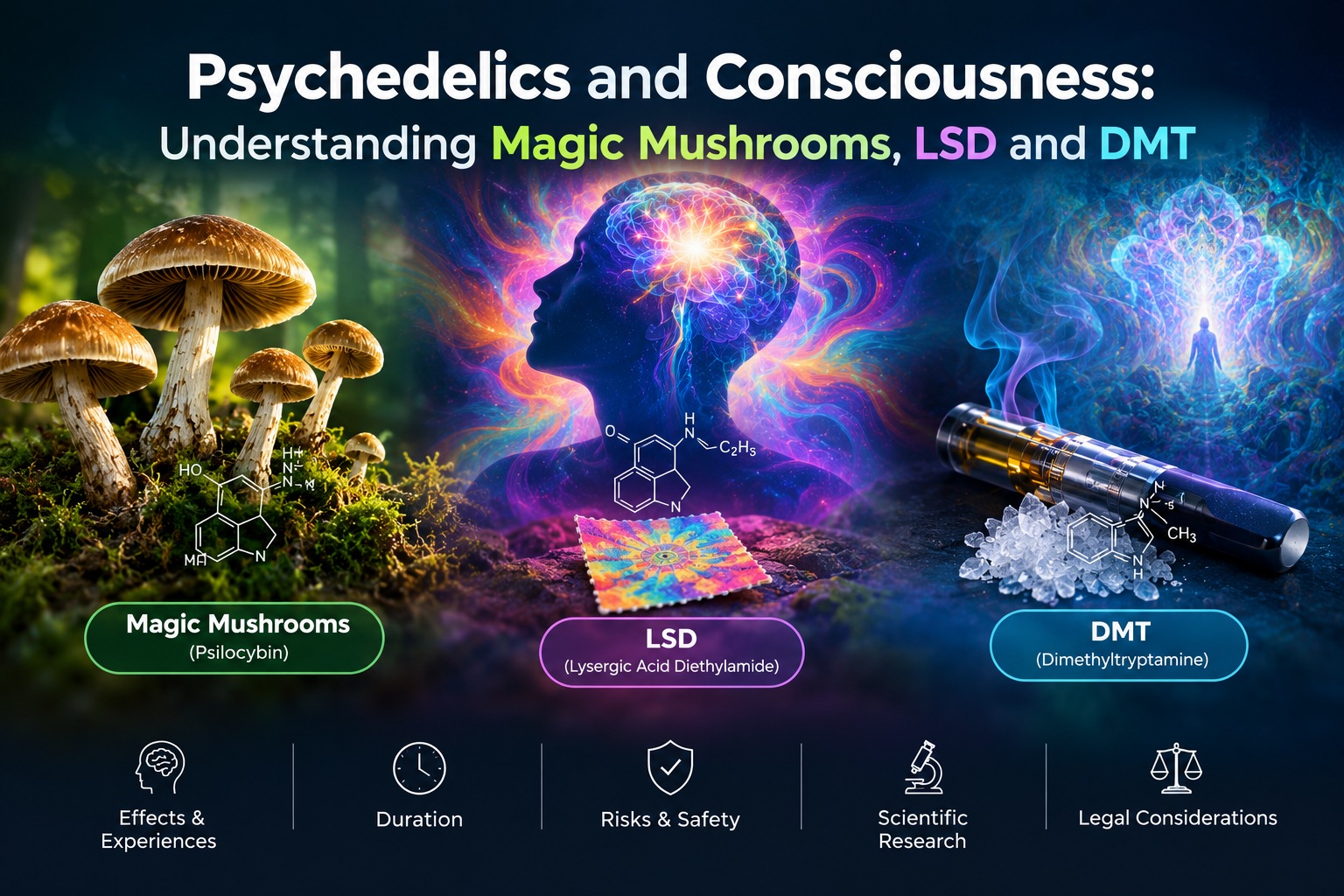
Psychedelics and Consciousness: Understanding Magic Mushrooms, LSD and DMT
People have explored altered states of consciousness through ritual, meditation, music and psychoactive plants for centuries. Today, three names appear regularly in conversations about psychedelic experiences: psilocybin mushrooms, LSD and DMT. Although they are often grouped together, they are not interchangeable. Their chemistry, duration, intensity and psychological effects can differ considerably.
This guide explains those differences in plain English. It looks at how each substance is commonly described, why set and setting matter, what current research can and cannot tell us, and why legal status and personal risk should never be ignored. It is intended as educational information, not medical advice, a dosing guide or encouragement to use illegal drugs.
If you are researching products or terminology, Exodelics’ pages on psilocybin mushrooms, LSD and DMT provide useful starting points. Always check the law where you live and seek professional advice before making decisions about your health.
What makes a psychedelic experience different?
Psychedelics can change perception, emotion, attention and the sense of self. People may notice brighter colours, altered sound, unusual associations, changes in time perception or a stronger focus on thoughts and feelings. These effects are not guaranteed, and the same substance can feel very different from one occasion to another.
Several factors shape the experience. The substance and its strength are important, but so are mood, expectations, surroundings, sleep, physical health and the people present. This combination is often described as “set and setting”. A calm environment cannot remove every risk, but stress, conflict or an unfamiliar setting can make fear and confusion more likely.
It is also important to distinguish a reported experience from a proven benefit. Someone may describe insight, creativity or spiritual meaning without that outcome being predictable or clinically established. Research into psychedelic-assisted therapy is developing, but therapeutic treatment involves screening, preparation, supervision and follow-up. It is not the same as taking a substance outside a clinical setting.
Magic mushrooms and psilocybin mushrooms
Magic mushrooms contain psilocybin, which the body converts into psilocin. Psilocin affects serotonin signalling and can change perception, emotion and thought. Different species and preparations can vary substantially in potency, which makes the effects difficult to predict.
What are the reported effects of magic mushrooms?
People commonly describe a gradual change in mood and perception. Colours may appear more vivid, surfaces may seem to move, and music or ordinary sounds can feel unusually absorbing. Some people experience visual patterns or imagery. Others notice a strong inward focus, emotional sensitivity or a sense of connection with nature and other people.
The experience may begin after a delay and can last for several hours. The timing depends on the substance, preparation, individual physiology and other factors. Delayed onset can create a risk of taking more before the first effects have appeared. FRANK notes that the strength of mushrooms is difficult to predict and that effects can include nausea, anxiety, paranoia, confusion and hallucinations. Its magic mushrooms information is a useful independent source for effects and risks.
A difficult experience can involve panic, frightening thoughts, loss of coordination or impaired judgement. The emotional tone may also shift rapidly. A person who begins feeling relaxed can become overwhelmed if the setting changes or the experience becomes more intense than expected.
What are people interested in when they discuss psilocybin?
Modern research has examined psilocybin-assisted therapy for conditions including depression and end-of-life distress. Early findings are interesting, but they should not be presented as proof that mushrooms are a general treatment. Clinical studies use carefully selected participants, controlled preparations, trained professionals and structured psychological support.
Outside research settings, people also report curiosity about creativity, reflection and spirituality. Those reports may help explain the appeal of psychedelic experiences, but they do not establish a reliable outcome for every person. Anyone experiencing depression, anxiety, trauma or another mental-health difficulty should speak with a qualified healthcare professional rather than self-treating.
LSD: a longer and more stimulating psychedelic
LSD, or lysergic acid diethylamide, is a potent synthetic psychedelic. It is active in very small amounts and is commonly associated with changes in sensory perception, thought patterns and the experience of time. Compared with psilocybin mushrooms, LSD is often described as longer-lasting and more mentally stimulating, although individual reactions vary.
How is an LSD experience commonly described?
The onset can be gradual. Early effects may include heightened colours, shifting patterns, increased alertness and a feeling that time is moving unusually quickly or slowly. At stronger points, people may notice elaborate geometric imagery, rapid associations and intense focus on music or conversation.
Some people describe a reduced sense of ordinary identity, sometimes called ego dissolution. This can feel meaningful or liberating, but it can also be frightening. When a person is confused about who they are, where they are or how long the experience will last, reassurance and a safe environment become especially important.
LSD effects can continue for much longer than many people expect. A long duration means that a person may still be impaired when they need to travel, make decisions or respond to an emergency. Driving or cycling while intoxicated is unsafe and may be illegal. Combining LSD with alcohol, stimulants, prescription medicines or other psychoactive substances can make reactions less predictable.
Is LSD linked with creativity or therapy?
LSD has a history in experimental psychotherapy and has been discussed by artists, writers and scientists. Contemporary research has renewed interest in psychedelic-assisted therapy, but research participation is not the same as recreational use. Claims that LSD reliably improves creativity, solves emotional problems or produces spiritual insight are too broad. Outcomes depend on the person, the context and many variables that are difficult to control.
People with a personal or family history of psychosis, mania or severe bipolar symptoms should take particular care. The NHS guidance on causes of psychosis identifies LSD and psilocybin-containing mushrooms among substances that can trigger psychotic episodes in some people. This is one reason professional screening matters.
DMT and why duration does not equal safety
DMT, or dimethyltryptamine, is a powerful psychedelic associated with extremely rapid and intense changes in consciousness. It occurs in some plants and is also produced in other forms. DMT is associated with ayahuasca in some traditional and ceremonial contexts, while other products are designed for inhalation.
What are the reported DMT effects?
People often describe DMT effects as sudden, immersive and visually complex. The experience may feel as though the surrounding environment has disappeared or been replaced by rapidly changing imagery. Some people report a sense of entering another space or encountering apparently autonomous figures. These interpretations are subjective experiences, not evidence that an external dimension or being has been objectively encountered.
The short apparent duration can be misleading. A very intense experience can feel much longer than clock time, and a person may remain shaken, confused or emotionally vulnerable after the main effects have subsided. Rapid onset also leaves little time to adjust if fear or disorientation develops.
DMT is not automatically safer because the acute experience may be brief. A person can still fall, panic, injure themselves, have a dangerous interaction with another substance or experience a serious mental-health reaction. Any inhaled product also raises questions about contents, concentration and contamination. Product names and packaging are not substitutes for independent laboratory verification.
Magic mushrooms, LSD and DMT compared
The simplest comparison is duration and style, not a ranking of which substance is “best”. Psilocybin mushrooms are often described as emotionally rich and connected to nature, with effects lasting several hours. LSD is usually associated with a longer period of alertness, patterning and abstract thought. DMT is commonly described as the most abrupt and immersive of the three.
Visual experiences may also differ. Psilocybin imagery is often described as organic, fluid or nature-oriented. LSD imagery is frequently described as geometric, symmetrical or highly patterned. DMT imagery is often described as fast-moving, dense and otherworldly. These descriptions are tendencies, not rules, and a person’s expectations can shape how they interpret what they see.
The emotional effects overlap more than the marketing language sometimes suggests. Any of the three can be enjoyable, unsettling, confusing or profound. Anxiety, paranoia and loss of control are possible with all psychedelics. A positive story about one person’s experience does not predict another person’s response.
The main risks people should understand
Mental health vulnerability
Psychedelics can intensify existing emotions and may worsen anxiety, paranoia or other symptoms. The NHS states that drug misuse and high doses of drugs can trigger psychosis, and lists LSD and psilocybin mushrooms among substances that may be involved. Anyone with current mental-health symptoms, a history of psychosis or mania, or relevant family history should discuss risks with a clinician.
Uncertain strength and contents
Natural mushrooms vary by species, growing conditions and preparation. Illicitly sold liquids, blotters, powders, edibles and cartridges may contain a different substance from the one advertised. No online description can guarantee identity, purity or potency. This uncertainty is particularly important when products are labelled with a strain name or a claimed amount.
Accidents and impaired judgement
Hallucinations and altered coordination can make roads, water, heights, traffic, machinery and unfamiliar places dangerous. A person who is intoxicated may not recognise the seriousness of a situation. A sober, trusted support person and a quiet, familiar environment can reduce some situational risks, but they cannot make an illegal or untested product safe.
Drug combinations and medicines
Mixing psychoactive substances can produce unpredictable effects. Alcohol may worsen confusion and poor judgement. Stimulants may increase agitation and physical stress. Prescription medicines can interact in ways that require medical advice. Do not stop prescribed treatment or change medication because of information in an online blog.
If someone becomes unresponsive, has a seizure, experiences severe agitation, has chest pain, struggles to breathe or may have eaten a poisonous mushroom, call 999. Tell emergency staff what was taken, when it was taken and whether anything else was involved. Accurate information can help clinicians provide safer treatment.
UK law and responsible information
The legal position is separate from the question of effects. GOV.UK lists LSD and magic mushrooms among Class A drugs. The government states that maximum penalties for Class A possession can include up to seven years in prison, an unlimited fine or both; supply and production can carry up to life imprisonment, an unlimited fine or both. See the current GOV.UK drug penalties guidance and
controlled drugs list for official information.
Rules can change and may differ between countries. A product being advertised online, described as a research chemical or shipped in discreet packaging does not establish that it is legal, safe or approved for human consumption. Readers should obtain current legal advice where necessary and should not rely on a retailer’s claims about legality.
How to approach psychedelic information critically
A responsible approach starts with evidence rather than promises. Look for clear descriptions of uncertainty, independent health information and accurate legal context. Be cautious of claims that a substance is guaranteed to heal trauma, improve intelligence, eliminate depression or produce a particular spiritual outcome.
It is also worth separating three questions: What does the substance do? What risks might apply to this person? What does the law allow? A product page may describe intended effects, but it cannot answer the second question for someone with a medical condition or medication, and it cannot replace official legal guidance.
For general reading, Exodelics’ edibles category and DMT category can help readers understand the terminology used across the market. These internal links are provided for navigation and product-category context only; they should not be interpreted as a health endorsement or a statement that any product is legal in the UK.
FAQs about magic mushrooms, LSD and DMT
Are magic mushrooms, LSD and DMT the same thing?
No. Psilocybin mushrooms contain psilocybin, LSD is a synthetic lysergamide, and DMT is a tryptamine psychedelic. They can all alter perception and mood, but their onset, duration, intensity and risks differ.
Which psychedelic lasts the longest?
LSD is commonly associated with the longest overall experience of the three, while psilocybin mushrooms typically last several hours and inhaled DMT is often described as brief but extremely intense. Actual duration varies with the substance, preparation, individual biology and other factors.
Can psychedelics treat depression or anxiety?
Clinical research is investigating psilocybin and other psychedelics in carefully controlled therapy settings. That does not mean an unregulated product or unsupervised use is an established treatment. If you are experiencing depression, anxiety, trauma or suicidal thoughts, contact a qualified healthcare professional or urgent support service.
Are psychedelics addictive?
Classic psychedelics are not generally described as producing the same pattern of physical dependence as some other drugs, but that does not mean they are risk-free. Tolerance can develop, problematic use is possible, and psychological harms or accidents can occur. A person can also become dependent on the belief that a substance is the only way to cope.
Is DMT safe because the experience is short?
No. Short duration does not remove risks associated with intensity, panic, impaired judgement, unknown contents, interactions or mental-health vulnerability. DMT should not be treated as safe simply because the main effects may pass relatively quickly.
Are magic mushrooms legal in the UK?
Magic mushrooms containing psilocin or psilocybin are controlled as Class A drugs in the UK. Laws and penalties should be checked through current official sources such as GOV.UK. Do not assume that fresh, dried, edible or liquid formats have a different legal status.
What should I do if someone is having a dangerous reaction?
Call 999 for urgent symptoms such as unconsciousness, seizures, breathing difficulties, chest pain, severe agitation or suspected poisoning. Stay with the person if it is safe, remove nearby hazards and tell medical staff exactly what was taken. Do not delay emergency care while searching online for a solution.
Final thoughts
Magic mushrooms, LSD and DMT can all produce powerful changes in perception and consciousness, but they should not be treated as interchangeable lifestyle products. Differences in duration, potency, setting and personal vulnerability can shape the outcome, and a compelling account of insight does not cancel the risks.
The most useful information is balanced information: it explains possible experiences, acknowledges uncertainty, points to independent evidence and makes the law clear. Anyone researching psychedelics should prioritise health, consent, privacy and professional advice over promotional promises.
Editorial note: This article is for general education only. It does not provide dosing or purchasing instructions, diagnose conditions or recommend illegal drug use. Information about medicines, mental health and UK law can change; consult a qualified professional and current official guidance.