
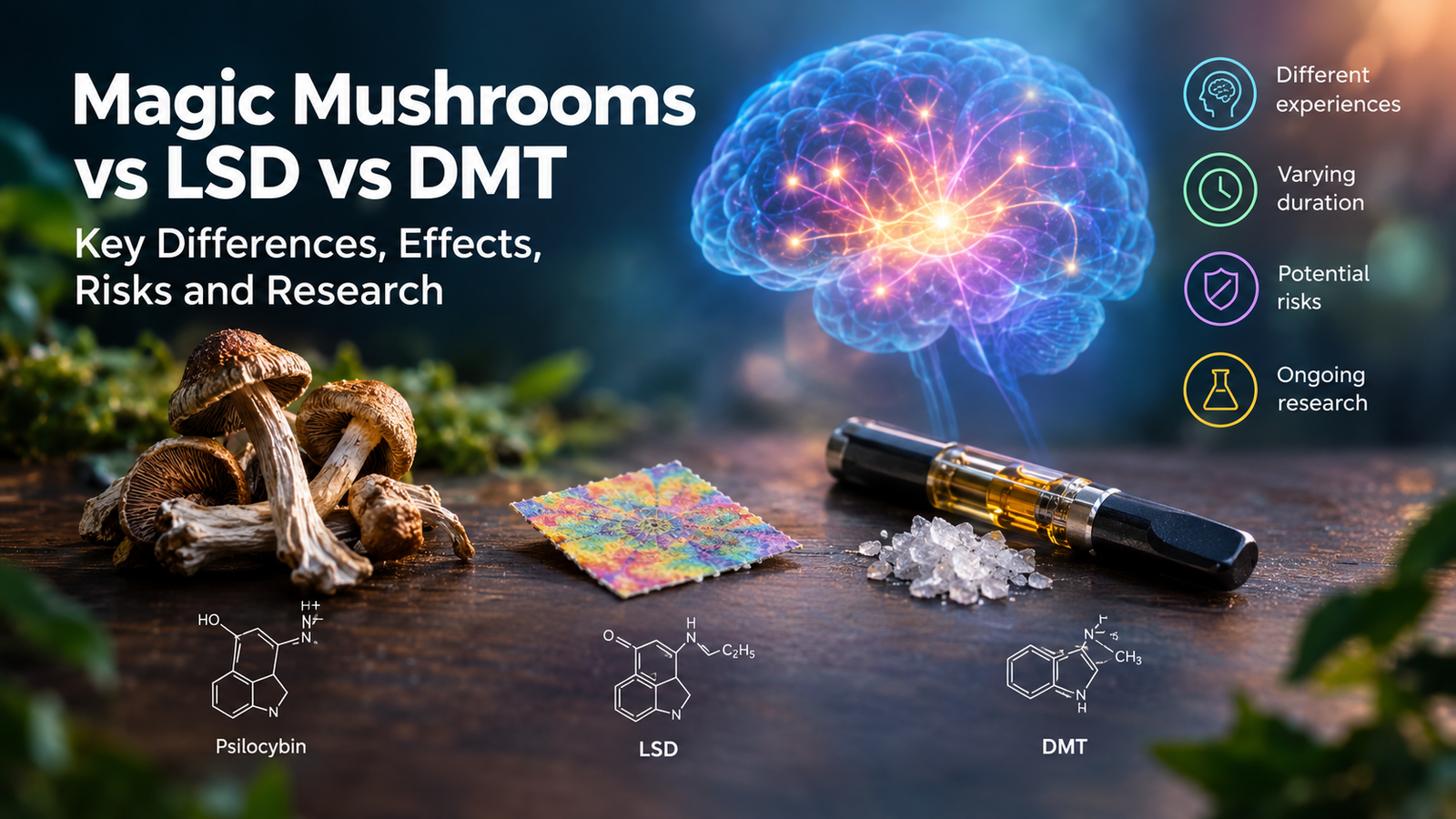
Magic Mushrooms vs LSD vs DMT: Understanding the Differences
Psychedelic substances have attracted attention across history, culture, philosophy and modern neuroscience. Among the best-known examples are magic magic mushrooms vs LSD vs DMT. Although these substances are often discussed together, they are not interchangeable. They differ in their chemistry, typical duration of effects, subjective experiences and the amount of scientific evidence available about their possible therapeutic applications.
Understanding the differences between magic mushrooms vs LSD vs DMT requires more than comparing visual effects or descriptions of intense experiences. It also means looking at how these compounds interact with the brain, why individual responses vary, what researchers have discovered so far and which risks should not be overlooked.
This guide explores each substance separately before comparing their reported effects, duration, research potential and safety considerations. It also explains why personal experiences should not be confused with proven medical benefits.
What Are Psychedelic Substances?
Psychedelics are psychoactive substances that can significantly alter perception, mood, thought processes and a person’s sense of time or self. Depending on the substance and the individual, these changes may involve unusual visual experiences, intensified emotions, altered sensory perception or a feeling of being disconnected from ordinary surroundings.
Classic psychedelics, including psilocybin, LSD and DMT, affect serotonin signalling in the brain. Their actions at serotonin receptors, particularly the 5-HT2A receptor, are considered important to their perception-altering effects. However, the precise relationship between these biological changes and the complex experiences people report is still being investigated.
The term psychedelic experience does not automatically mean a positive or meaningful experience. Some people describe feelings of wonder, emotional openness or connection. Others may experience confusion, fear, panic or disturbing changes in their perception of reality.
The effects are influenced by multiple factors, including the substance’s identity and potency, a person’s physical and psychological state, other medicines or substances, and the surrounding environment. For that reason, no description can predict exactly how an individual will respond.
1. Magic Mushrooms and Psilocybin
What are magic mushrooms?
Magic mushrooms are a general name for certain fungi containing psilocybin and related psychoactive compounds. Psilocybin is converted in the body into psilocin, which contributes to the changes in perception, mood and cognition associated with psilocybin mushrooms.
The concentration of psychoactive compounds can vary between species and individual specimens. Appearance alone is not a reliable way to identify a mushroom or establish its chemical content. Misidentification of wild fungi is a serious concern because some poisonous species can resemble mushrooms that contain psilocybin.
For more information about their chemistry and pharmacology, readers can consult the European Union Drugs Agency’s overview of hallucinogenic mushrooms.
What are the reported effects of magic mushrooms?
Descriptions of psilocybin effects often include changes in colour perception, visual patterns, emotional intensity and the sense of time. Some people report that music, natural surroundings or memories seem unusually vivid. Others describe introspection, a different perspective on familiar thoughts or a sense of connection with their environment.
Emotional responses can vary considerably. Feelings of happiness, curiosity or calm may occur, but so can anxiety, sadness, confusion or fear. Changes in judgement and perception may also make it more difficult to respond appropriately to ordinary situations.
The term psilocybin experience therefore covers a wide range of possible reactions rather than one predictable sequence of events.
How long do magic mushroom effects last?
The duration depends on factors such as the material involved, its potency, individual biology and the circumstances of exposure. Effects are commonly described as lasting several hours, but the experience can vary and residual changes may persist after the most noticeable effects have faded.
A simple timeline cannot reliably predict the intensity or duration for a particular person. Nor does a shorter or longer experience necessarily indicate a better or more beneficial outcome.
What does research say about psilocybin?
Psilocybin is receiving scientific attention for its potential role in carefully supervised mental health treatment. Researchers have investigated its use alongside psychological support for conditions including depression and other difficult-to-treat psychiatric problems.
It is important to distinguish a clinical trial from unsupervised use. Research protocols involve defined procedures, screening, trained professionals, monitoring and follow-up. Findings from such settings cannot be assumed to apply to mushrooms obtained outside a clinical environment.
Psilocybin is not a universally established treatment for mental health conditions, and a psychedelic experience by itself is not evidence of therapeutic improvement. Anyone experiencing persistent mental health symptoms should seek advice from an appropriately qualified healthcare professional rather than attempting to replace established care with an unregulated substance.
2. LSD: A Synthetic Psychedelic
What is LSD?
LSD stands for lysergic acid diethylamide. It is a potent synthetic psychedelic first synthesised by Swiss chemist Albert Hofmann in 1938. Its psychoactive properties were identified later, and the compound became associated with scientific investigations, counterculture and experiments in psychology during the twentieth century.
LSD is active at very small quantities and can produce pronounced changes in perception, mood and thought. Its effects are linked in part to serotonin receptor activity, although the full explanation of its subjective effects remains an active area of scientific study.
LSD is often discussed alongside psilocybin because both are classic psychedelics. Nevertheless, they are different chemical compounds and their effects can differ in duration, intensity and character.
What are the reported effects of LSD?
Reports of LSD effects include intensified colours, geometric or repeating visual patterns, changes in the perception of movement and time, and shifts in the way thoughts and emotions are experienced. Some people describe a flow of unusual associations or a feeling that ordinary ideas have taken on new significance.
Emotional responses may range from excitement and fascination to anxiety, agitation or panic. A person’s sense of self can also feel different, sometimes becoming less distinct or familiar. These experiences may be interpreted in spiritual, philosophical or personal terms, but the interpretation does not establish that a particular insight is factually accurate.
LSD can impair judgement and the ability to distinguish subjective impressions from external events. This matters because an individual may feel unusually certain about a thought or perception even when it does not reflect reality.
How long do LSD effects last?
LSD generally has a longer duration than the commonly reported effects of psilocybin mushrooms or inhaled DMT. Its effects may continue for many hours, and difficulty sleeping or feeling mentally unsettled can continue beyond the most intense phase.
The exact duration is not fixed. It can be influenced by individual factors and by uncertainty about what a substance actually contains. The long-lasting nature of LSD’s effects is one important difference when comparing LSD with other psychedelics.
What is known about LSD and psychotherapy?
LSD was investigated in psychiatric and psychological research during the mid-twentieth century. Scientific interest in psychedelics has since returned, although modern research standards and clinical safeguards differ from historical practice.
Researchers continue to examine how psychedelics might affect psychological processes and whether certain compounds could have a role in carefully controlled treatment. Evidence for one compound, diagnosis or treatment protocol should not be treated as proof for another.
Claims that LSD reliably improves creativity, resolves trauma or provides lasting personal growth are too broad. Some people report meaningful experiences, but personal accounts cannot establish consistent clinical benefits. There are also potential harms, including acute anxiety, impaired judgement and persistent perceptual disturbances in some cases.
3. DMT: A Short-Acting but Intense Psychedelic
What is DMT?
DMT, or N,N-dimethyltryptamine, is a psychedelic compound found in a variety of plant sources and studied in different forms. It is associated with ayahuasca, a traditional psychoactive brew used in some Indigenous and ceremonial contexts. DMT has also been investigated in modern scientific settings.
DMT should not be confused with 5-MeO-DMT, which is a distinct compound with a different pharmacological profile. Nor should the effects of inhaled DMT automatically be treated as equivalent to those of ayahuasca. The preparation, route of exposure and other compounds present can change the overall effects and risks.
The phrase DMT vape refers to a delivery format rather than a guarantee of a known or consistent product. The actual contents, concentration and purity of unregulated products may be uncertain.
What are the reported effects of DMT?
Reports of DMT effects commonly describe abrupt changes in sensory perception, vivid imagery, unusual spatial experiences and a pronounced alteration in the sense of self or surroundings. Some individuals interpret their experiences as encounters with beings or unfamiliar environments. These are subjective reports, not proof that a person has entered a separate physical reality or encountered an independently verified entity.
The experience may be emotionally intense. Feelings of amazement or unity can occur, but fear, disorientation and overwhelming confusion are also possible. Because the onset can be rapid, a person may have little time to adjust to the sudden change in perception.
The intensity of a DMT experience does not establish that it is psychologically beneficial, safe or more profound than another psychedelic experience.
How long do DMT effects last?
Some forms of inhaled DMT are associated with a much shorter main experience than LSD or psilocybin. However, duration varies with the form of DMT, the route of exposure, the product and individual factors. Ayahuasca, for example, has a different overall time course from inhaled DMT because it is a different preparation with additional active compounds.
A brief main effect should not be mistaken for an absence of risk. Acute psychological distress, physical reactions, impaired awareness and unsafe behaviour can occur even during a short-lived experience. The period afterwards may also involve confusion or difficulty processing what happened.
What does research say about DMT and ayahuasca?
Scientists have investigated DMT and ayahuasca in relation to consciousness, brain function and possible mental health applications. However, these are distinct research areas, and results cannot automatically be transferred from one preparation to another.
Research remains limited in important respects, and questions about safety, clinical effectiveness, interactions and which people might be at greater risk remain significant. Reports of psychological insight or spiritual significance are valuable as descriptions of human experience, but they do not prove that DMT treats depression, anxiety or post-traumatic stress disorder.
People considering mental health treatment should discuss evidence-based options with a qualified professional instead of relying on claims about unregulated psychedelic products.
4. Magic Mushrooms vs LSD vs DMT: Key Differences
Although magic mushrooms, LSD and DMT belong to the broad category of classic psychedelics, their differences are important.
| Feature | Magic mushrooms | LSD | DMT |
|---|---|---|---|
| Main compound | Psilocybin, converted into psilocin | Lysergic acid diethylamide | N,N-dimethyltryptamine |
| Origin | Certain fungi | Synthetic compound | Found in some plants; can also be synthesised |
| General effect profile | Changes in perception, mood and thought | Changes in perception, cognition and time perception | Often rapid, intense changes in perception and awareness |
| Typical duration | Several hours, with substantial variation | Commonly many hours | Often shorter for inhaled DMT; varies by preparation |
| Subjective reports | Emotional shifts, visual changes, introspection | Visual patterns, altered thought associations, time distortion | Vivid imagery, rapid changes in awareness, altered sense of surroundings |
| Research focus | Psilocybin-assisted treatment and neuroscience | Historical and ongoing investigations of psychedelic effects | Consciousness, pharmacology and early-stage clinical research |
| Important uncertainty | Mushroom identity and compound concentration can vary | Potency and actual substance may be uncertain outside regulated settings | Formulation, route and composition can vary substantially |
This table provides a general overview, not a way to predict an individual’s response. The substances differ in chemistry and time course, and effects can vary considerably even when people report using the same compound.
Differences in perception and emotion
Descriptions of magic mushrooms often emphasise changes in emotion, sensory perception and introspection. LSD is frequently associated with a prolonged alteration in perception and thought. DMT is commonly described as producing rapid, intense changes in awareness.
These are broad descriptions of reported experiences, not fixed categories. The effects of any of these substances may be positive, neutral or distressing, and the same person may respond differently on separate occasions.
Differences in duration
Duration is one of the most noticeable distinctions when comparing psychedelic substances. LSD typically lasts longer than the main effects reported for psilocybin mushrooms, while some forms of inhaled DMT have a much shorter main time course.
Duration alone is not a measure of safety. A brief experience can still involve acute danger, while a long experience may create prolonged difficulties with sleep, judgement or emotional regulation.
5. Psychedelics, Creativity and Spiritual Experiences
Magic mushrooms, LSD and DMT are often discussed in connection with creativity, spirituality and personal growth. Some people describe feeling more open to ideas, noticing familiar surroundings differently or experiencing a strong sense of connection. Others interpret their experiences through religious, philosophical or existential frameworks.
These accounts can be meaningful to the people who report them. However, there is a difference between describing a subjective experience and demonstrating a reliable effect.
For example, feeling unusually creative does not necessarily mean that the quality of a person’s work has objectively improved. A sense of certainty about a new idea does not guarantee that the idea is accurate. Similarly, a powerful spiritual experience does not establish that it will lead to lasting improvements in wellbeing.
Research into creativity and psychedelic states remains complex. Findings may depend on the compound, the design of the study, the setting, the measures used and what happens after the acute effects have ended. It is therefore more accurate to discuss creativity and spirituality as reported experiences and research questions rather than guaranteed benefits.
6. What Does Current Psychedelic Research Tell Us?
Interest in psychedelic science has grown as researchers examine the effects of compounds such as psilocybin, LSD and DMT on perception, emotion and brain activity.
Some clinical studies of psilocybin-assisted treatment have reported encouraging results for particular mental health conditions. Yet these studies generally use controlled protocols, screening, psychological support and structured follow-up. Their results do not establish that taking mushrooms independently will produce the same outcomes.
The European Union Drugs Agency explains that psychedelic research is developing but that regulatory approval and availability for medical treatment must be considered separately from promising early findings. Readers can consult its FAQ on the therapeutic use of psychedelic substances.
It is also important not to generalise across substances. Evidence concerning psilocybin does not establish the effectiveness of LSD or DMT, and findings about ayahuasca do not necessarily apply to DMT in other forms.
Clinical research must establish not only whether an intervention may help but also who might benefit, who could be harmed, how risks can be reduced and whether improvements persist. Until these questions are adequately answered for a particular treatment, broad claims about psychedelic therapy should be treated cautiously.
7. Risks and Safety Considerations
A balanced discussion of psychedelic effects must include possible harms. These substances can alter perception, judgement and emotional responses in ways that are difficult to predict.
Potential concerns include:
- Anxiety and panic: An intense change in perception can become frightening or overwhelming.
- Confusion and impaired judgement: A person may struggle to interpret their surroundings or make safe decisions.
- Physical reactions: Effects can include nausea, changes in heart rate or blood pressure, sweating, dizziness or other unwanted symptoms.
- Mental health concerns: People with certain psychiatric vulnerabilities may face increased risks from altered perception and intense emotional experiences.
- Uncertain contents: Products obtained outside regulated settings may contain unexpected substances or have an unknown concentration.
- Accidental poisoning: Misidentifying wild mushrooms can lead to serious or fatal poisoning.
- Medication and substance interactions: Combining psychoactive substances or taking them alongside medicines may introduce additional risks that require professional assessment.
No simple list can identify every person who might experience a complication. The fact that a substance is naturally occurring does not make it safe, and a history of positive experiences does not guarantee that a future experience will be uncomplicated.
If someone develops severe confusion, loses consciousness, has a seizure, experiences chest pain, has difficulty breathing or appears to be in immediate danger, seek emergency medical assistance. Do not leave an acutely unwell person alone.
8. Legal Considerations in the United Kingdom
The legal status of psychedelic substances varies by country and can depend on the substance, preparation and circumstances. In the United Kingdom, LSD and psilocybin-containing magic mushrooms are controlled under the Misuse of Drugs Act 1971 as Class A drugs. Unauthorised possession, supply and production can carry serious legal consequences.
The relevant government guidance lists LSD and magic mushrooms among Class A drugs and explains that penalties depend on the offence and circumstances. See the official UK government guidance on drug penalties.
DMT is also subject to UK drug-control legislation. Anyone seeking to understand the position of a particular substance, preparation or activity should consult current official legislation or qualified legal advice rather than relying on general online statements.
This section is general educational information, not individual legal advice. Laws may differ outside the UK, so readers in other jurisdictions should check their own local requirements.
Conclusion: Understanding the Differences Between Magic Mushrooms, LSD and DMT
Magic mushrooms, LSD and DMT share some broad psychedelic characteristics, but they differ in their chemistry, reported effects, typical duration and research history. Psilocybin mushrooms are associated with changes in perception and emotion; LSD often produces a longer-lasting alteration in thought and sensory experience; and some forms of DMT are associated with a rapid, intense and shorter-lived main experience.
Descriptions of creativity, spirituality and personal insight help explain why these substances attract attention, but they should not be confused with established medical outcomes. Research into psychedelic-assisted treatment is evolving, and the conditions under which a compound is studied matter greatly when interpreting its results.
The most useful way to understand psychedelic science is to combine curiosity with critical thinking. Reliable information should explain not only the experiences people report, but also the limits of current evidence, the potential for harm and the legal context in which these substances are controlled.
Educational disclaimer: This article is intended for general information and is not medical or legal advice. It does not recommend the use or purchase of controlled substances, and it should not replace advice from qualified healthcare or legal professionals.