
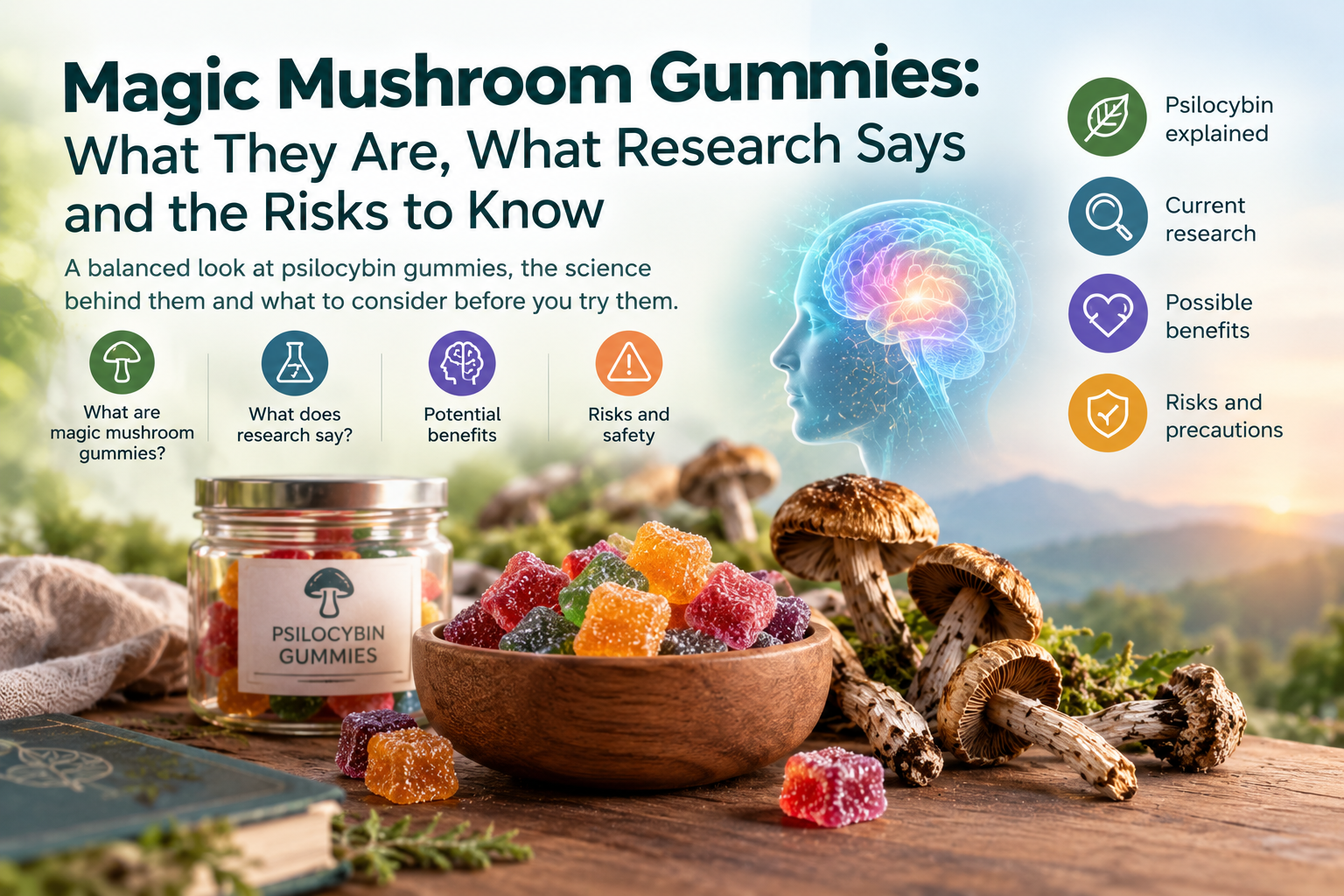
Magic Mushroom Gummies: What They Are, What Research Says and the Risks to Know
Magic mushroom gummies are often marketed as a convenient alternative to dried mushrooms. They may look and taste like ordinary sweets, which can make them seem approachable, discreet and easy to understand. However, appearance is not proof of contents, strength or legality. A responsible discussion needs to cover both the reasons people are interested in psilocybin gummies and the uncertainties that come with unregulated products.
This guide explains what people mean by magic mushroom gummies, how psilocybin can affect perception and mood, what research says about therapeutic use and microdosing, and which safety issues deserve attention. It is educational information only. It does not provide dosing instructions, recommend illegal drug use or claim that gummies are a treatment for any health condition.
For terminology and category navigation, readers can explore Exodelics’ pages on psilocybin mushrooms,
edibles and
LSD. These internal links do not establish that any product is legal, medically approved, accurately labelled or safe for human consumption.
What are magic mushroom gummies?
Psilocybin mushrooms contain psilocybin, a compound that the body converts into psilocin. Psilocin affects serotonin signalling and can alter perception, emotion, attention and the experience of time. In a gummy, the active ingredient may be derived from mushrooms, produced synthetically or replaced by another compound. The label may not always make that distinction clear.
That uncertainty is one of the most important differences between a regulated clinical preparation and a product purchased through an informal or unregulated market. A gummy can contain less active material than claimed, more than claimed, no psilocybin at all or an unexpected psychoactive ingredient. Research into psilocybin cannot automatically validate every product sold as a mushroom gummy.
The National Center for Complementary and Integrative Health explains that the effects of psilocybin can vary according to the amount taken, the type of mushroom, a person’s mood and expectations, their health, the setting and whether other drugs are involved. The same principle applies when the substance is placed in a sweet or edible format.
Why do people choose the gummy format?
Taste and texture
Dried mushrooms can have an earthy flavour and chewy texture that some people dislike. A flavoured edible may be easier to swallow and may mask that taste. This is a genuine practical difference in presentation, but it should not be confused with a change in pharmacological risk. A pleasant flavour can make a psychoactive product easier to consume, and that may make it easier to underestimate its strength.
Flavours such as fruit, cola, berry or citrus are primarily sensory choices. They do not make psilocybin more therapeutic, reduce the chance of anxiety or guarantee a smoother experience. If a product uses a name suggesting a special process, such as a citrus or “lemon” preparation, readers should look for independent evidence rather than assuming the marketing language describes a standardised medical formulation.
Portability and appearance
Edibles are small and easy to carry, but discretion is not the same as safety. A gummy can be mistaken for ordinary confectionery by children, visitors or pets. It should never be left in an accessible place or stored in packaging that could be confused with regular sweets.
The appearance of a gummy also provides no reliable information about its contents. Bright colour, branded packaging and a stated amount are not substitutes for validated laboratory testing. The source article’s claim that a particular gummy contains a precise amount should therefore be treated as a product-specific claim, not a general fact about all mushroom gummies.
The idea of predictable effects
An edible may appear more measured than a piece of dried mushroom. In principle, a carefully manufactured and independently tested product could be more consistent. In practice, many online or informal products do not provide the same quality controls as a licensed medicine. Even when the amount of an ingredient is stated, the label may refer to mushroom material rather than psilocybin itself, or may omit other active ingredients.
This distinction matters because “milligrams of mushroom” and “milligrams of psilocybin” are not interchangeable. Readers should be wary of unusually precise claims that are not supported by a batch number, certificate of analysis and a credible testing laboratory.
What effects are associated with psilocybin?
Psilocybin can change the way people experience colour, sound, body sensations, thoughts and time. Some people report euphoria, wonder, emotional openness or a stronger appreciation of music and nature. Others may experience nausea, confusion, anxiety, paranoia, panic or frightening hallucinations.
The experience is influenced by mindset and surroundings as well as by the substance. Someone who feels distressed, sleep-deprived or pressured may be more vulnerable to an unpleasant reaction. A difficult experience can include a loss of control or impaired judgement. The FRANK guide to magic mushrooms notes that effects may take more than 30 minutes to appear and can last for several hours, while strength is difficult to predict.
Edibles also create a specific timing risk. A person may not feel effects immediately and may wrongly assume the product is weak. Taking more during that delay can increase the chance of an unexpectedly intense experience. This article does not provide a schedule or dose; the safer point is that delayed onset makes self-assessment difficult.
What are the claimed benefits of magic mushrooms?
Online discussions commonly associate psilocybin with creativity, mood, emotional insight, empathy, spirituality and personal growth. These reports help explain why interest in magic mushrooms has increased, but personal testimonials are not the same as clinical evidence.
Creativity and cognitive flexibility
Some people describe unusual connections between ideas or a temporary break from familiar thought patterns. Laboratory research has explored divergent thinking and other measures of creativity, but the findings are mixed and context-dependent. A person may feel imaginative without producing better decisions, more accurate work or useful long-term solutions.
Psilocybin can also impair concentration, coordination and judgement. It would be misleading to present a psychedelic edible as a dependable productivity aid. Creative work may feel different during or after an experience, but that does not prove a predictable improvement in creative performance.
Emotional insight and personal reflection
A psychedelic experience can bring attention to memories, relationships and emotions. Some people later describe a greater sense of perspective or a desire to change habits. Reflection can be meaningful, especially when supported by a trusted professional, but it can also be emotionally difficult. Insight does not automatically translate into lasting change, and an intense experience is not a substitute for therapy.
Spiritual experiences and connectedness
People have used psychoactive plants in cultural and ceremonial contexts for a long time. Some modern users describe a feeling of unity, awe or connection. These accounts are subjective and can be personally important, but they should not be presented as proof of a particular spiritual explanation or as a guaranteed outcome of consuming gummies.
What does the research say about therapeutic psilocybin?
Clinical research has examined psilocybin-assisted therapy for depression, anxiety associated with serious illness and some forms of addiction. In these studies, psilocybin is usually combined with preparation, professional support and follow-up. The study setting is a central part of the intervention.
The NCCIH summarises evidence suggesting possible short- and medium-term improvements in depression when psilocybin is combined with psychological support. It also describes research into alcohol-use disorder and anxiety or existential distress in serious medical illness. At the same time, it highlights small samples, limited follow-up, expectancy effects and the need for more research.
Those findings cannot be transferred directly to commercial magic mushroom gummies. Clinical participants may be screened for psychiatric and medical risks. The material may be prepared to a known standard. The session may be supervised by trained staff. Participants may receive psychological support before and after the experience. A gummy consumed outside that structure does not reproduce those safeguards.
It is also inaccurate to say that psilocybin gummies are an established treatment for depression, anxiety, PTSD or ADHD. Research interest is not the same as approval, and people should not delay appropriate medical care while experimenting with an unregulated product.
Microdosing: popular claims versus current evidence
Microdosing generally refers to taking an amount intended to produce subtle or barely noticeable effects. Users may hope for better focus, mood, creativity or productivity. These claims are widely repeated online, but the evidence remains incomplete.
A 2022 double-blind, placebo-controlled study of 34 people examined low-dose dried Psilocybe cubensis mushrooms. The active condition produced noticeable subjective effects, but the researchers found no evidence of improved wellbeing, creativity or cognitive function across most measures. Some results suggested small changes towards impaired performance. The authors concluded that expectations may account for at least part of the benefits reported in anecdotes. Read the study at PMC.
This does not prove that every person experiences no benefit. It does show why strong claims about microdosing psilocybin should be qualified. Product inconsistency, expectancy, individual differences and the absence of long-term safety data all make conclusions difficult. Microdosing may also affect sleep, anxiety, mood, concentration and physical comfort.
A gummy labelled as a “microdose” is not automatically a standardised microdose. The label may be inaccurate, the active compound may be unknown and the product may contain a larger amount than expected. People taking prescription medicines or managing a mental-health condition should speak with a qualified clinician before considering any psychoactive substance.
Safety issues that should not be overlooked
Mental-health vulnerability
Psilocybin can intensify fear, confusion and unusual beliefs. The NCCIH warns about risks including anxiety, paranoia, hallucinations and persistent psychosis, and says psilocybin is not safe for people with psychotic conditions such as schizophrenia or schizoaffective disorder, or severe forms of bipolar disorder. Anyone with relevant symptoms or a family history should seek medical advice.
Unknown contents and contamination
A package that looks professional may still contain an unexpected substance. Edibles can be mislabelled, contaminated or made with a different psychoactive ingredient. This is especially concerning when products are sold without independent testing or clear traceability.
Accidental ingestion
Because gummies resemble sweets, they create a risk of accidental ingestion by children and animals. Keep any psychoactive edible away from other food, clearly separated and inaccessible. If someone may have eaten an unknown gummy, contact emergency services or poison advice without waiting for symptoms to intensify.
Mixing substances
Combining psilocybin with alcohol, stimulants, cannabis, prescription medicines or other psychedelics can make effects less predictable. No online guide can determine whether a combination is safe for a particular person. Do not stop prescribed medication without advice from the clinician responsible for your care.
When to call for urgent help
Call 999 if someone becomes unconscious, has a seizure, experiences breathing problems, chest pain, severe agitation or suspected poisoning. Tell emergency staff what was taken, how much may have been involved and when. Accurate information can help clinicians respond quickly.
Set, setting and integration
“Set” refers to a person’s mindset, expectations and emotional state. “Setting” includes the physical environment and the people present. A calm, familiar environment may reduce some situational risks, but it cannot make an unknown or illegal product safe.
Integration refers to reflecting on an experience afterwards. Some people journal, speak with a trusted person or work with a therapist. Integration can help identify what was meaningful and what may need support. It should not be used to dismiss persistent anxiety, confusion, insomnia or unusual thoughts; those symptoms deserve professional attention.
UK legal context
In the UK, GOV.UK lists magic mushrooms among Class A drugs. The maximum penalties stated for Class A possession can include up to seven years in prison, an unlimited fine or both. Supply and production can carry up to life imprisonment, an unlimited fine or both. See the current GOV.UK drug-penalty guidance for official information.
The legal position is separate from claims about health benefits. A product being advertised online as an edible, supplement, research product or gummy does not prove that it is legal, tested or suitable for human use. Laws can change and may differ across jurisdictions.
What to check when reading product and research claims
Readers can assess claims more critically by asking a few simple questions. Does the article identify the active compound? Is the stated quantity mushroom material or psilocybin? Is the product independently tested? Are the benefits based on a clinical trial, a review, an animal study or testimonials? Were participants supervised and screened? Were results compared with a placebo, and how long did follow-up last?
These questions help separate genuine research from marketing language. “Natural”, “discreet”, “premium”, “microdose” and “therapeutic” are not scientific guarantees. Neither is a flavour name or a polished package.
For related terminology, Exodelics’ psilocybin mushroom category and
edibles category provide internal navigation. Readers comparing substances can also review the site’s
DMT page and
LSD page. These links are informational and do not replace medical, laboratory or legal advice.
FAQs about magic mushroom gummies
Are magic mushroom gummies the same as dried mushrooms?
Not necessarily. A gummy may contain mushroom material, extracted psilocybin, synthetic psilocybin or another psychoactive compound. The format does not prove the contents. Independent testing and clear product traceability are important, but many unregulated products cannot provide reliable verification.
Do mushroom gummies make psilocybin safer?
No. Flavour, texture and packaging do not remove mental-health, interaction, contamination or legal risks. An edible may also delay the onset of effects, making it easier for someone to take more before the first effects are felt.
Do psilocybin gummies help with depression or anxiety?
Clinical research is investigating psilocybin-assisted therapy for depression and anxiety, usually with professional screening and psychological support. That evidence does not establish that commercial gummies treat either condition. Anyone with symptoms should seek appropriate healthcare rather than self-treating.
Is microdosing psilocybin proven to improve focus and creativity?
No. Some people report benefits, but placebo-controlled research has not provided conclusive support for improved wellbeing, creativity or cognition. A 2022 study found noticeable subjective effects but no broad evidence of the claimed benefits and noted possible expectation effects.
Are magic mushrooms legal in the UK?
Magic mushrooms containing psilocybin or psilocin are controlled as Class A drugs in the UK. Possession, supply and production can carry serious penalties. Check current official guidance because laws and enforcement details can change.
Can psilocybin cause a bad experience?
Yes. Effects can include anxiety, panic, paranoia, confusion, nausea and frightening hallucinations. Risk may be higher when a person is distressed, in an unfamiliar setting, mixing substances or vulnerable to psychosis or mania.
What should I do if someone reacts badly to a gummy?
Stay with them if it is safe, remove nearby hazards and call 999 for serious symptoms such as unconsciousness, seizures, breathing difficulties, chest pain or severe agitation. Tell emergency staff exactly what was taken and when.
Conclusion
Magic mushroom gummies are a convenient edible format, but convenience should not be confused with consistency, safety or therapeutic value. Psilocybin can produce powerful changes in perception and emotion. Research into supervised psilocybin-assisted therapy is promising in some areas, while evidence for microdosing remains uncertain and product claims are often difficult to verify.
A responsible article should present both sides: why people are interested in psilocybin gummies and why label accuracy, mental-health history, interactions, UK law and emergency planning matter. Treat testimonials as personal reports, treat clinical findings as context-specific and consult a qualified professional about health concerns.
Editorial note: This article is for general education only. It does not provide dosing or purchasing instructions, diagnose conditions or recommend illegal drug use. Product contents can vary, and information about health and law can change. Consult a healthcare professional and current official guidance before making decisions.