
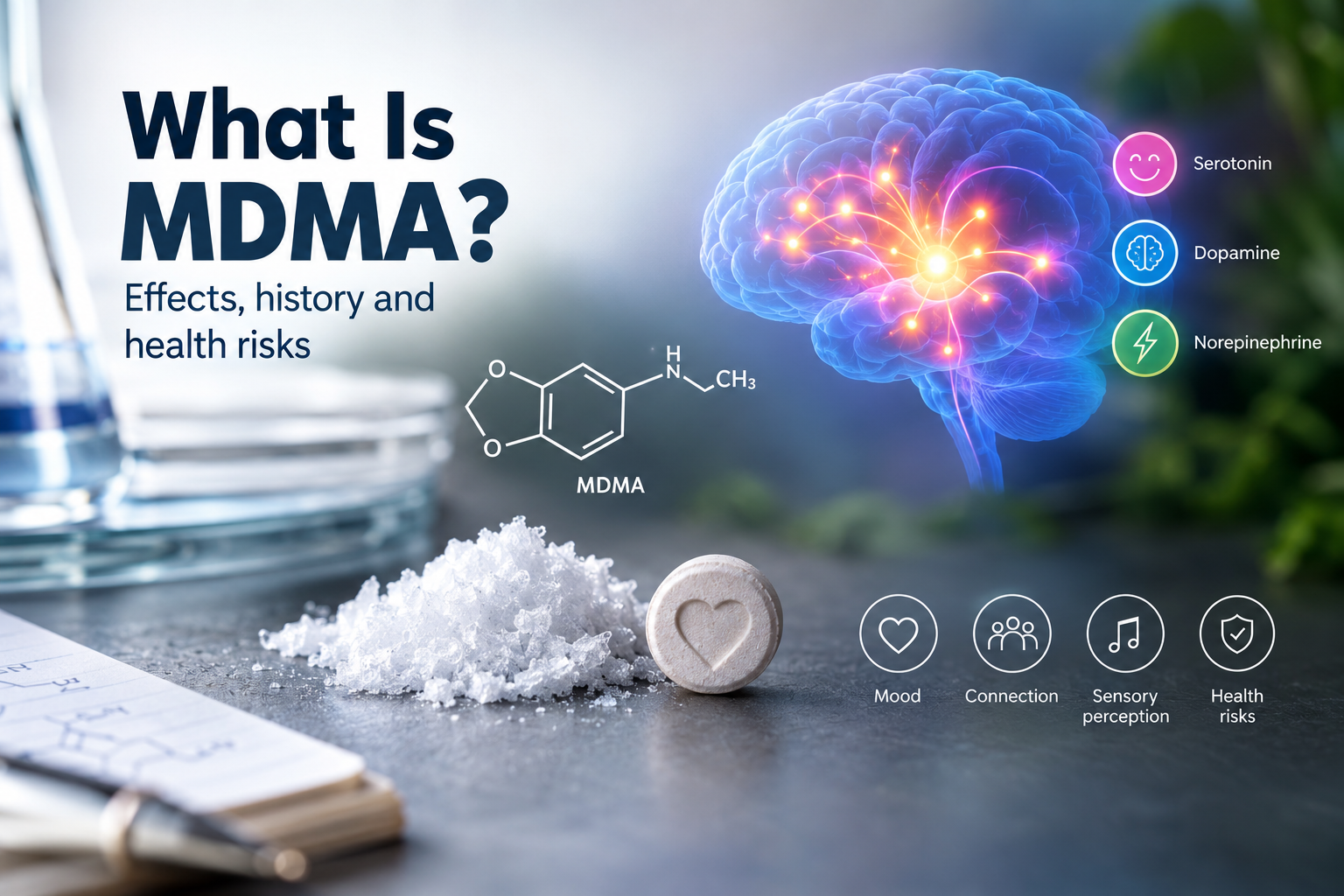
What Is MDMA? Understanding Its Effects, History and Health Risks
MDMA is a synthetic psychoactive substance associated with nightlife, social experiences and scientific research. It is often discussed under the name ecstasy, but these terms do not always describe exactly the same thing. Understanding the chemistry, reported effects and potential dangers of MDMA requires looking beyond its reputation in popular culture.
In this guide, we explore what MDMA is, how it affects the brain and body, how it differs from ecstasy, and what current research can and cannot tell us about its potential therapeutic applications.
What Is MDMA?
MDMA stands for 3,4-methylenedioxymethamphetamine. It is a synthetic psychoactive substance that affects several chemical signalling systems in the brain, particularly those associated with mood, arousal and social behaviour.
MDMA is commonly described as having both stimulant and entactogenic properties. The term entactogen refers to substances associated with changes in emotional awareness and perceived interpersonal connection.
People who take MDMA may report increased energy, elevated mood, emotional openness and greater sensitivity to sensory experiences. However, responses vary considerably, and these reported effects do not mean that the substance is safe or predictable.
MDMA can also cause serious physical and psychological complications, even when someone does not expect an adverse reaction.
MDMA and Ecstasy: What Is the Difference?
MDMA and ecstasy are frequently used interchangeably in everyday conversation, but there is an important distinction.
- MDMA: The name of a specific chemical compound.
- Ecstasy: A common street name usually associated with tablets marketed as containing MDMA.
- Molly: Another informal name often associated with MDMA in powder or crystal form.
The names and physical appearance of a product cannot confirm its chemical composition. Ecstasy tablets may contain varying amounts of MDMA, other psychoactive substances or unexpected adulterants. Products sold as Molly or MDMA are not necessarily pure either.
Consequently, it is inaccurate to assume that a powder or crystal is more reliable than a tablet simply because of its appearance.
For additional information on the risks associated with uncertain drug composition, consult the NHS Inform guide to MDMA.
A Brief History of MDMA
MDMA’s history begins in the early twentieth century. It was first synthesized at the German pharmaceutical company Merck in 1912 and included in a patent filed that year, which was granted in 1914.
The original historical record does not support the widely repeated claim that the substance was specifically developed as an appetite suppressant. Instead, MDMA appeared as an intermediate in chemical work connected with other compounds.
Its later history was different. Interest in its psychoactive properties grew during the twentieth century, including investigations into its possible use in psychological and psychotherapeutic settings. The substance subsequently became associated with nightlife and recreational drug use.
These different phases help explain why MDMA is discussed in such varied contexts today, from medicinal research to public health and drug policy.
For a scholarly account of its origins, see the published historical review indexed by PubMed.
How Does MDMA Affect the Brain?
MDMA influences neurotransmitter systems, including serotonin, dopamine and norepinephrine. These chemical messengers contribute to the regulation of mood, motivation, attention, arousal and other functions.
Its effects are complex and cannot be explained by a single neurotransmitter alone.
Commonly Reported Psychological Effects
Reported short-term effects may include:
- Elevated mood or euphoria.
- Increased feelings of emotional openness or social connection.
- Greater energy and alertness.
- Changes in the perception of music, touch and other sensory experiences.
Not everyone experiences these effects in the same way. Anxiety, panic, confusion, agitation and other unwanted psychological responses are also possible.
Physical Effects on the Body
MDMA can increase heart rate, blood pressure and body temperature. Other reported effects include muscle tension, jaw clenching, sweating, nausea and difficulty sleeping.
In serious cases, overheating and disturbances in the body’s water and salt balance can become life-threatening. Cardiovascular complications and organ damage are also possible.
The risks depend on multiple factors, including the substance’s actual composition, individual health, environmental conditions and interactions with other drugs or medicines.
How Long Can MDMA Effects Last?
The onset, intensity and duration of MDMA’s effects vary between individuals and products. Published health information commonly describes several hours of noticeable effects, but this is not a reliable prediction for a particular person.
The effects may also continue to influence sleep, mood and concentration after the most noticeable subjective effects have subsided.
Some people report fatigue, low mood, irritability, anxiety or difficulty sleeping in the following hours or days. These experiences are sometimes described informally as an MDMA comedown.
There is no single timeline that applies to everyone, and a person’s subjective impression of the effects does not establish that the substance has left the body.
MDMA and Sexuality: What Does Research Suggest?
MDMA is sometimes described as a “love drug” because some people report increased emotional openness, closeness and sensitivity to touch.
However, emotional intimacy and sexual functioning are not the same thing. Some individuals report reduced sexual performance, difficulty reaching orgasm or other unwanted changes.
Experiences differ, and personal accounts should not be treated as proof of a predictable effect. MDMA can also affect judgement and decision-making, making consent, boundaries and other aspects of sexual health important considerations.
Claims about using MDMA to improve relationships should therefore be approached cautiously, particularly when they involve taking the substance outside a medically supervised research setting.
MDMA in Clinical Research and Psychotherapy
Researchers have investigated MDMA-assisted psychotherapy, particularly in relation to post-traumatic stress disorder (PTSD). This research examines whether the substance may have a role within a structured therapeutic intervention involving clinical assessment, professional supervision and psychological support.
It is important to distinguish an investigational treatment from established routine medical care. Research findings from a controlled clinical setting cannot automatically be applied to unsupervised use, and potential benefits must be weighed against adverse effects and limitations in the evidence.
MDMA should not be considered a proven self-treatment for trauma, depression, relationship difficulties or other mental health conditions.
For background on the current scientific understanding of MDMA, visit the National Institute on Drug Abuse (NIDA).
Is MDMA a Psychedelic?
MDMA is usually distinguished from classic psychedelics such as LSD and psilocybin, although scientific classifications sometimes vary.
Classic psychedelics are generally associated with substantial changes in perception, thought and the experience of reality. MDMA is more commonly described as a stimulant with entactogenic effects, although it can also alter aspects of perception.
The distinction is useful, but it should not suggest that one category is inherently safer than another. Each substance has its own pharmacology, potential adverse effects and research limitations.
What Are the Main Health Risks of MDMA?
MDMA can pose significant risks, including:
- Overheating: A dangerous rise in body temperature can lead to organ damage.
- Cardiovascular strain: Increased heart rate and blood pressure can be particularly concerning for people with underlying health problems.
- Fluid and electrolyte disturbances: Both dehydration and excessive water intake can create serious complications.
- Psychological effects: Anxiety, agitation, confusion and low mood may occur.
- Drug interactions: Combining MDMA with alcohol, other psychoactive substances or certain medicines can increase risks.
- Sleep and concentration difficulties: After-effects may interfere with normal functioning.
- Dependence and problematic use: Some individuals develop cravings or patterns of use that become difficult to control.
Severe overheating, seizures, collapse, marked confusion or loss of consciousness require urgent medical attention. Contact local emergency services if these symptoms occur.
For a detailed public-health overview, read NHS Inform’s information on MDMA and its risks.
MDMA, Regulation and Scientific Understanding
MDMA’s legal status differs between jurisdictions. Rules may address possession, production, supply, importation and medical research separately. A substance’s appearance in scientific literature does not establish that it is legal to possess or use in a particular country.
Anyone researching the topic should consult current legislation and official guidance relevant to their location.
Scientific understanding continues to develop, but important questions remain about long-term outcomes, individual susceptibility, drug interactions and the circumstances under which potential therapeutic applications could be appropriate.
Conclusion: Understanding MDMA Beyond Its Reputation
MDMA is a synthetic psychoactive substance with a complex history spanning chemistry, recreational drug culture and clinical research. Its effects on mood and social perception help explain its reputation, but they do not remove the possibility of serious harm.
Understanding the distinction between MDMA and ecstasy, recognising the limitations of claims about purity, and consulting credible scientific and public-health sources can help readers separate evidence from popular assumptions.
For further educational reading, explore the scientific and product-information resources available through Chemige, alongside independent medical and regulatory references.
Editorial note: This article is intended for educational purposes and does not provide medical advice or encourage the use of controlled or psychoactive substances.
Frequently Asked Questions About MDMA
What does MDMA stand for?
MDMA stands for 3,4-methylenedioxymethamphetamine. It is a synthetic psychoactive substance that affects neurotransmitter systems involved in mood, arousal and social behaviour.
Is MDMA the same as ecstasy?
Not necessarily. MDMA is a specific chemical compound, while ecstasy is a street term commonly used for tablets marketed as containing MDMA. Such products can contain different amounts of MDMA or other substances.
What are the effects of MDMA?
Reported effects include elevated mood, increased energy, emotional openness and heightened sensory awareness. Unwanted effects can include anxiety, nausea, muscle tension, overheating, cardiovascular strain and disturbances in fluid balance.
How long do the effects of MDMA last?
The duration varies according to individual factors and the substance’s composition. Noticeable effects may last several hours, while changes in sleep, mood and concentration can persist beyond that period.
Is MDMA addictive?
Some people develop cravings, psychological dependence or problematic patterns of use. The likelihood and severity of these problems vary, and repeated use can increase the risk of adverse physical and psychological outcomes.
Is MDMA used in psychotherapy?
MDMA has been investigated as part of structured psychotherapy research, including studies involving PTSD. Investigational treatment is different from unsupervised use, and research findings should not be interpreted as a recommendation to self-medicate.
Is MDMA considered a psychedelic?
MDMA is most commonly described as a stimulant with entactogenic effects. It is generally distinguished from classic psychedelics such as LSD and psilocybin, although some scientific sources use broader classifications.
What are the most serious health risks of MDMA?
Potentially serious complications include overheating, cardiovascular problems, electrolyte disturbances, seizures and organ damage. Combining MDMA with other substances or certain medicines can introduce additional risks. Severe symptoms require urgent medical attention.
Is MDMA legal in Germany or the UK?
The legal position depends on the jurisdiction and the specific activity involved. Possession, supply, production and research may be subject to different legal provisions. Consult current official legislation and government guidance rather than relying on informal claims online.