Where to Find Liberty Caps in the UK: Habitat, Identification and Safety
where to find liberty caps near me are one of the mushrooms most frequently discussed in connection with wild psychedelic fungi in the UK. Searches for terms such as liberty cap psilocybe, liberty cap mushroom, liberty caps mushroom, and magic mushroom map UK often reflect an interest in learning how these fungi are identified, where their natural habitat occurs, and what UK law says about them.
However, finding information about a mushroom is different from determining whether a particular wild specimen is safe to consume or whether collecting it is lawful.
This guide takes an educational approach to liberty caps, covering their general characteristics, habitat, identification challenges, seasonal considerations, safety concerns, UK legislation, and how to evaluate online mushroom information.
What Are Liberty Caps?
The name liberty cap is commonly used for Psilocybe semilanceata, a small mushroom associated with grassland habitats.
The species is known for its distinctive appearance and its association with psilocybin. Government information also identifies the liberty cap as a type of magic mushroom.
The scientific name Psilocybe semilanceata is therefore useful when researching the species because common names can vary between regions.
It is important to distinguish a common name from a verified scientific identification.
What Does a Liberty Cap Mushroom Look Like?
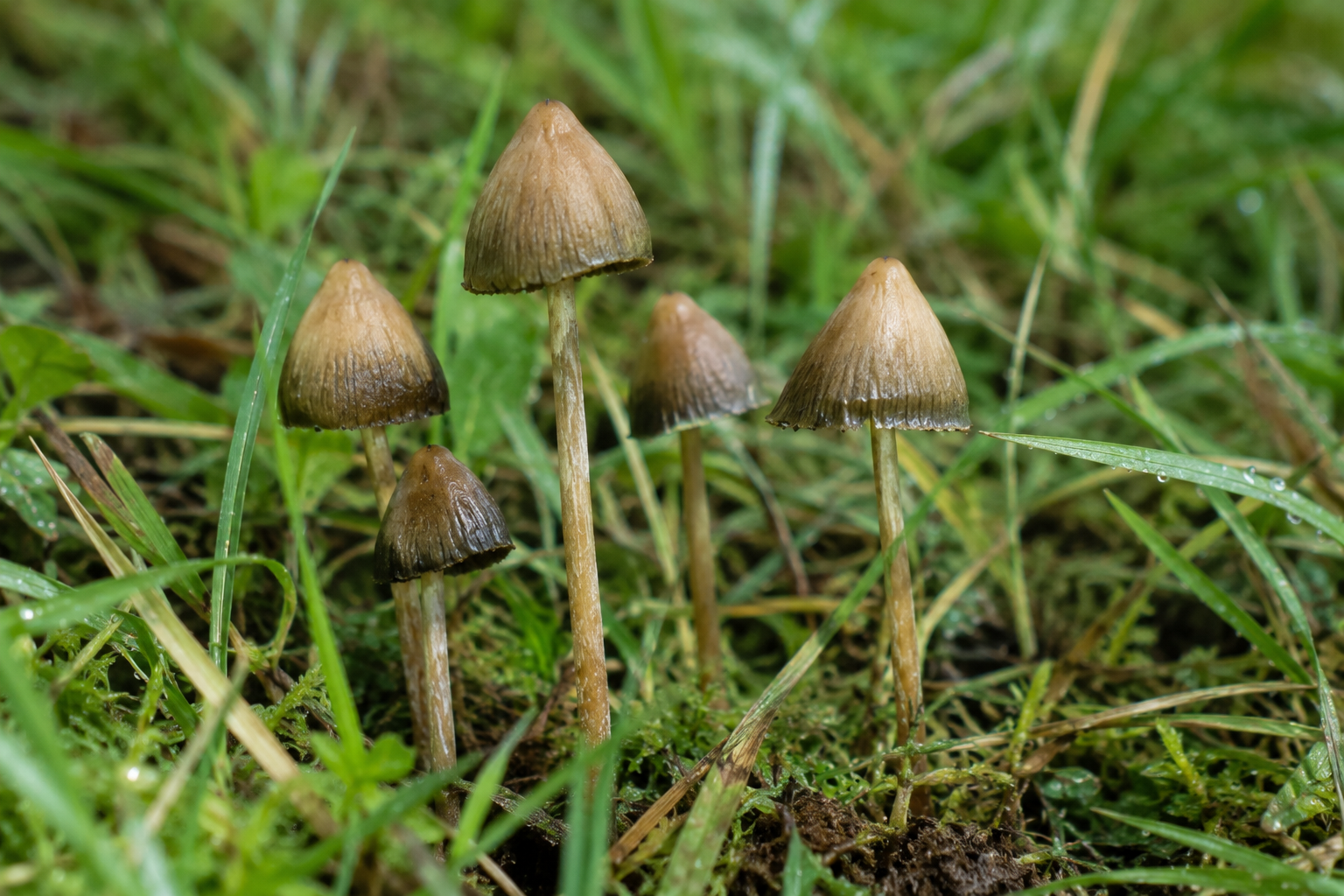
A typical liberty cap is relatively small and has a characteristically pointed or conical cap.
However, appearance alone is not sufficient to establish that a wild mushroom is safe to consume.
Wild fungi can share similar characteristics, and misidentification can have serious consequences. UK government information specifically warns that poisonous mushrooms can resemble magic mushrooms.
For this reason, photographs found through search engines, social media or mushroom forums should not be treated as definitive identification.
Liberty Cap Psilocybe and Its Natural Habitat
People searching for liberty caps psilocybe are often interested in the environmental conditions associated with Psilocybe semilanceata.
Liberty caps are generally associated with open grassland rather than conventional woodland environments. They are particularly discussed in relation to natural, uncultivated grassland habitats.
Environmental conditions can influence fungal fruiting, meaning that the presence of suitable habitat does not guarantee that mushrooms will be present.
This distinction is important when interpreting online claims about where liberty caps occur.
When Do Liberty Caps Appear?
The appearance of wild fungi is influenced by factors including:
- Temperature
- Rainfall
- Soil conditions
- Moisture
- Grassland characteristics
- Seasonal changes
- Local environmental conditions
Consequently, there is no universal date when liberty caps will appear everywhere in the UK.
Online discussions sometimes describe particular periods as the “liberty cap season,” but local conditions can vary considerably.
Why Are Liberty Caps Difficult to Identify?
One of the biggest problems associated with wild mushroom identification is that visually similar species can occur in the same environments.
A photograph may provide useful information, but it cannot necessarily establish:
- The exact species
- Whether a specimen is contaminated
- Whether it has deteriorated
- Whether it contains another species mixed with it
- Whether an identification made online is correct
The consequences of misidentifying a poisonous mushroom can be serious.
Therefore, liberty caps searches should be approached as an opportunity to learn about fungal identification rather than as confirmation that a particular wild mushroom is safe.
What Is a Magic Mushroom Map UK?
The phrase magic mushroom map UK can refer to maps, databases, community reports or online resources that attempt to show where particular fungi have been observed.
Such resources need to be interpreted carefully.
A map may show:
- Historical observations
- Broad distribution patterns
- Ecological records
- User-submitted observations
- General habitat information
A map does not necessarily prove that a mushroom is currently present at a particular location.
Nor does a map substitute for reliable species identification.
For educational purposes, distribution databases can be useful for understanding fungal ecology and biodiversity without treating them as directions for collecting controlled fungi.
Why Online Mushroom Locations Can Be Misleading
Search results can create the impression that a particular location is guaranteed to contain liberty caps.
In reality, fungal fruiting can change from year to year.
Reports can also become outdated, while photographs may have been taken under different environmental conditions.
A statement such as “liberty caps grow here” therefore does not necessarily mean that the species is currently present.
This is particularly important when interpreting social-media posts, forums and user-generated maps.
Liberty Caps and Psilocybin
The interest surrounding liberty caps is largely connected with psilocybin.
Psilocybin is a psychedelic compound associated with changes in perception, cognition, mood and sensory experience.
The effects of psychedelic mushrooms can vary between individuals and circumstances.
Possible effects may include:
- Changes in visual perception
- Altered perception of time
- Changes in thought patterns
- Heightened emotions
- Confusion
- Anxiety
- Panic or paranoia
Government information also identifies risks including sickness and the possibility of accidentally consuming a poisonous mushroom.
Why Mushroom Identification Matters
A major issue with wild liberty cap mushroom searches is the assumption that a mushroom can be identified safely from a single photograph.
That assumption can be dangerous.
Identification should take into account multiple characteristics rather than relying on one feature such as cap shape or colour.
Even experienced mushroom enthusiasts can encounter difficult identification cases.
If there is uncertainty about a wild mushroom, consuming it is not a safe way to test an identification.
Liberty Caps and UK Law
The legal position is particularly important for people searching for liberty caps mushroom UK information.
Current UK government information lists magic mushrooms as Class A drugs. The government’s controlled-drug list states that fungi containing psilocin or an ester of psilocin are controlled as Class A.
UK government information also records that raw magic mushrooms were classified as Class A drugs in July 2005.
The exact application of drug legislation can depend on the circumstances, so current official guidance should be consulted rather than relying on claims made by websites, forums or social-media posts.
Are Liberty Caps Legal in the UK?
A common misconception is that wild mushrooms are automatically legal because they grow naturally.
That is not a reliable assumption for mushrooms containing controlled substances.
The UK controlled-drug framework specifically covers fungi containing psilocin or psilocybin-related compounds.
Therefore, people researching magic mushroom map UK or liberty cap psilocybe information should distinguish between studying the species as part of mycology and activities involving controlled mushrooms.
Can You Trust a Liberty Cap Identification Online?
Online identification can be useful for learning, but it has limitations.
Before accepting a claim about a mushroom, consider:
- Is the scientific name provided?
- Are multiple identifying characteristics discussed?
- Is the information from a credible mycological source?
- Is the photograph clear enough to evaluate?
- Does the source acknowledge similar-looking species?
- Is the information current?
- Does the source distinguish identification from confirmation?
- Does the source provide appropriate safety warnings?
A confident statement on social media is not necessarily evidence of correct identification.
Liberty Caps vs Other Wild Mushrooms
Liberty caps can be discussed alongside many other small grassland fungi.
However, similar appearance does not mean identical species.
Differences can involve:
- Cap morphology
- Stem characteristics
- Spore characteristics
- Habitat
- Growth pattern
- Microscopic features
- Geographic distribution
For serious mycological identification, specialist references and qualified expertise are more appropriate than relying exclusively on online photographs.
The Importance of Responsible Foraging
Foraging can be an enjoyable way to learn about fungi, but wild mushroom collection carries inherent identification risks.
Responsible mushroom enthusiasts should understand that:
- Not every mushroom is edible.
- Similar-looking species can have very different properties.
- Online identification is not infallible.
- Natural habitats should be respected.
- Local access and land-management rules may apply.
- Controlled species raise additional legal considerations.
The safest educational approach is to learn about fungal ecology and identification without assuming that a visually similar mushroom is safe to consume.
Scientific Research Into Psilocybin
Psilocybin continues to be studied in neuroscience and clinical research.
Research involving psychedelic substances takes place under controlled conditions involving defined substances, screening procedures and professional monitoring.
Those conditions are fundamentally different from encountering an unidentified mushroom growing outdoors.
Scientific research should therefore not be interpreted as evidence that an unidentified wild mushroom is safe to consume.
How to Research Liberty Caps Responsibly
When researching liberty cap psilocybe or liberty mushroom, separate three different types of information:
Mycological information
Information about taxonomy, identification, ecology and distribution.
Scientific information
Research concerning psilocybin, fungi and psychedelic effects.
Legal information
Current legislation concerning controlled fungi and related activities.
Keeping these categories separate makes it easier to distinguish scientific evidence from personal experience and commercial claims.
What About “Liberty Cap Finder” Websites?
Websites describing themselves as liberty cap finders, mushroom maps or seasonal trackers may contain user-generated information.
Such resources should be treated cautiously.
A report from another person does not guarantee that a mushroom is present today, and it does not establish that a photographed specimen has been correctly identified.
For educational research, broad ecological and biodiversity resources are generally more useful than relying on specific collection claims.
Final Thoughts
Searching for where to find liberty caps near me often leads to maps, forum discussions and social-media reports. However, the most useful way to approach the subject is to understand the species, its general habitat, identification challenges, environmental requirements and legal status.
The liberty mushroom, commonly associated with Psilocybe semilanceata, is a species of significant interest in mycology and psychedelic research. However, wild mushroom identification carries genuine risks, particularly when visually similar species are involved.
For UK readers, the legal position is equally important. Current UK government sources classify magic mushrooms as Class A drugs and list fungi containing psilocin or an ester of psilocin among controlled substances.
Anyone researching magic mushroom map UK, liberty cap psilocybe, or liberty mushroom should therefore distinguish educational information about fungal distribution from instructions for obtaining controlled mushrooms, and should verify current legal information through authoritative UK sources.
This article is intended for educational and mycological information. It does not provide locations, coordinates or instructions for collecting controlled mushrooms and is not medical or legal advice.
Frequently Asked Questions
What are liberty caps?
Liberty caps are the common name generally used for Psilocybe semilanceata, a small mushroom associated with grassland habitats.
What is a liberty cap mushroom?
A liberty cap mushroom is a common name for Psilocybe semilanceata. Identification should not be based solely on appearance or online photographs.
What does liberty cap psilocybe mean?
The phrase generally refers to Psilocybe semilanceata, the scientific name associated with the liberty cap.
What is a magic mushroom map UK?
The term can refer to online maps or databases showing reported observations or general distribution information about fungi. Such resources should not be treated as guaranteed current locations or identification tools.
When do liberty caps appear?
Their appearance depends on environmental conditions such as temperature, moisture, rainfall and habitat. Timing can vary between locations and years.
Are liberty caps legal in the UK?
UK government information currently lists magic mushrooms as Class A drugs, while its controlled-drug list covers fungi containing psilocin or an ester of psilocin.
Can a liberty cap be identified from a photograph?
A photograph may help with preliminary study, but it should not be treated as definitive proof of species identification or safety.
Are liberty caps dangerous?
There are risks associated with psychedelic mushrooms, including psychological effects and the possibility of accidentally consuming a poisonous mushroom through misidentification.
Where can I learn more about liberty caps?
Reliable mycological references, biodiversity databases, scientific literature and current government information are better sources than unverified social-media claims or commercial listings.