Magic Mushroom Map UK: A Responsible Guide to Mushroom Education, Identification and Safety
Magic Mushroom Map UK: An Educational Starting Point
Interest in fungi, foraging and psychedelic culture has grown rapidly in the UK. A magic mushroom map can appear useful to people who want to learn about species, habitats and seasonal patterns. However, any responsible resource should do more than point people towards locations. It should provide accurate identification information, explain legal boundaries, encourage environmental care and make safety the priority.
This guide is designed for education rather than procurement. It does not provide directions for finding, buying, cultivating or consuming illegal drugs. Instead, it explains how readers can approach the subject responsibly and why a good magicmushroommap should be treated as an information resource, not a guarantee that a mushroom is safe or lawful to possess.
Important: Never eat a wild mushroom based only on a photograph, map pin, social-media post or artificial-intelligence identification. Misidentification can cause serious illness or death.
What Is a Magic Mushroom Map?
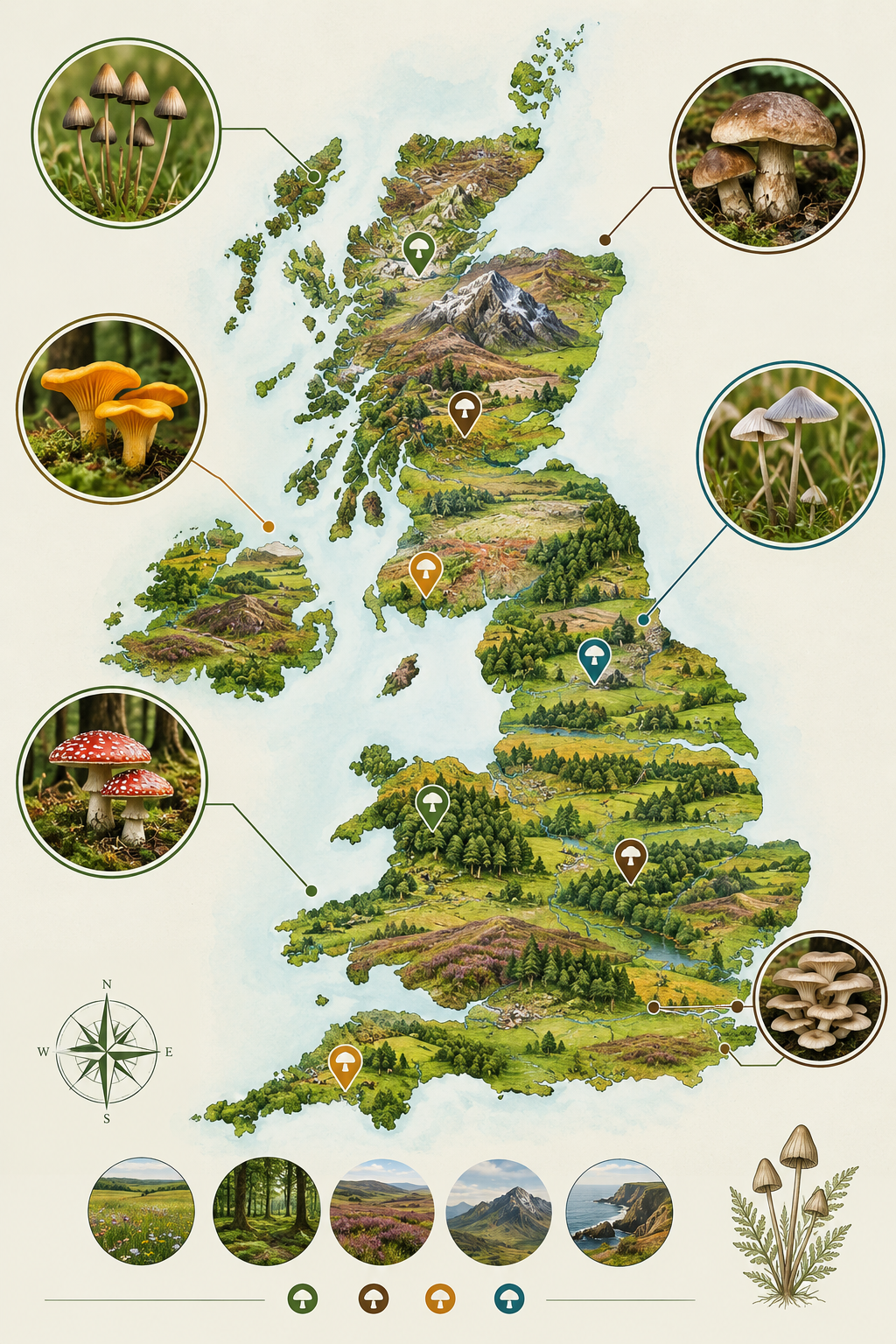
A magic mushroom map is generally an online guide that combines species information, broad habitat knowledge, seasonal observations and educational resources. The best versions avoid publishing sensitive or precise locations. They focus on helping readers understand fungal diversity, responsible observation and the difference between identification and possession.
Map data can be incomplete or misleading. Weather, land management, soil conditions and local ecology change from year to year. A map may also contain user-submitted reports that have not been verified. For those reasons, visitors should regard a magic mushroom map as a learning aid rather than an authority on species identity, legality or availability.
A high-quality resource should make the following distinctions clear:
| Topic | What a responsible resource should explain |
| Identification | Visual features are clues, not proof. Confirmation requires expert-level knowledge and, in some cases, microscopic examination. |
| Location data | Broad ecological information is safer and more useful than exact pins that could encourage trespass or over-collection. |
| Legality | UK rules can apply to possession, supply, production and preparation, not only to sale. |
| Conservation | Wild fungi support ecosystems and should not be damaged or stripped from habitats. |
| Safety | Uncertain identification means the mushroom should not be consumed. |
Understanding the Liberty Caps Mushroom
The liberty caps mushroom is a common name associated with Psilocybe semilanceata, a small grassland fungus known for its distinctive pointed cap. It is often discussed in UK foraging and psychedelic communities because it can appear in suitable habitats during the cooler, wetter months. The common name is not enough to establish identity, and appearance can vary with age, weather and growing conditions.
Several small brown mushrooms can resemble one another. A novice observer may overlook important differences in cap shape, stem features, spore colour, habitat or texture. Some dangerous fungi can also be mistaken for more familiar species. This is why a photograph, map entry or comparison chart cannot replace qualified identification.
Anyone researching a liberty caps mushroom should also understand that recognition is not permission. The legal status of a species and the legality of possessing or preparing it are separate from the question of whether it can be identified in the wild. Readers should consult current official UK guidance and avoid relying on anonymous online claims.
“Where to Get Psychedelic Mushrooms”: A Safer Way to Search
People often search online for where to get psychedelic mushrooms. That phrase can lead to unreliable sellers, illegal supply, scams, unsafe products and content that encourages trespass or risky foraging. A responsible website should not direct readers to dealers, hidden markets, private land or specific collection sites.
A safer interpretation of the search is to provide information about lawful alternatives and education. Readers can study mycology through local natural-history groups, attend supervised identification walks, visit museums or botanical collections, and learn about UK drug law from official sources. These options support knowledge without turning a public website into a procurement directory.
If someone has already consumed an unknown mushroom and feels unwell, they should seek urgent medical assistance. They should keep any remaining material or packaging available for clinicians, but should not delay treatment while trying to identify the specimen online. The getting medical help immediately when poisoning is suspected.
Using “Mushroom Near Me” Responsibly
The phrase mushroom near me is useful for finding general information about fungi, local nature groups, public mycology events and reputable identification services. It should not be used as a shortcut to an exact wild-mushroom collection point.
Before visiting any countryside location, check land-access rules, public rights of way, nature-reserve restrictions and local conservation guidance. Do not enter private land without permission. Do not disturb protected habitats. Avoid trampling grassland, removing large quantities of fungi or sharing precise locations that could attract irresponsible harvesting.
A responsible local search can focus on:
•public mushroom identification events;
•local records centres and natural-history societies;
•council or reserve guidance on collecting;
•reputable books and field guides;
•qualified experts who can assess specimens safely.
These approaches make the search for mushroom near me more useful for learning about biodiversity than for pursuing uncertain consumption.
Mushroom Spores UK: Education, Law and Biosecurity
Searches for mushroom spores UK often mix legitimate microscopy and mycology interests with cultivation-related questions. Spores are microscopic reproductive cells, and their legal treatment can differ from that of mature fungi or preparations. The distinction is technical and may depend on the intended use and the substance involved.
Anyone researching mushroom spores should check current official guidance before ordering, importing, possessing or distributing them. Do not assume that a product labelled “for microscopy” is automatically risk-free or lawful in every context. Avoid vendors that make unsupported health claims, conceal contents or encourage customers to bypass regulations.
Good biosecurity also matters. Unknown specimens and imported materials can introduce contaminants or invasive organisms. Keep research materials clearly labelled, follow supplier and laboratory safety guidance, and never release cultivated or imported organisms into the environment.
MagicMushies, Online Claims and Product Quality
The term magicmushies is informal and is often used in social posts, forums and online shops. Informal terminology can obscure important differences between species, preparations, potency and contaminants. A colourful label or confident product description is not proof of identity, strength or safety.
Readers should be cautious about claims that a product is “natural,” “legal everywhere,” “microdose-safe” or “non-psychoactive.” Natural substances can still cause poisoning, adverse reactions and interactions with medicines. Products sold through unregulated channels may also contain unexpected compounds or inaccurate doses.
A responsible magicmushroommap site should explain these risks clearly. It should not publish vendor lists, purchasing instructions, dosage schedules or methods for concealing possession. Its role should be to improve public understanding and reduce preventable harm.
Key Safety Principles for Wild Fungi
The safest rule is simple: do not consume a wild mushroom unless its identity has been confirmed by a genuinely qualified expert and consumption is lawful. Even experienced foragers can make mistakes, particularly when specimens are young, damaged or weathered.
Do not rely on one feature. Identification should consider the whole specimen, its habitat and relevant microscopic or chemical characteristics where appropriate. Do not taste-test an unknown mushroom. Do not assume that cooking removes all toxins. Do not trust a group consensus formed from a single low-quality image.
If poisoning is suspected, seek emergency medical help promptly. Symptoms may include nausea, vomiting, abdominal pain, confusion, agitation, drowsiness, hallucinations, seizures or breathing difficulties. Do not induce vomiting unless instructed by a medical professional. In the UK, call 999 for a severe or rapidly worsening reaction and follow . For broader clinical context on drug misuse and dependence, consult the .
How to Choose a Trustworthy Magic Mushroom Map
Not every website using the phrase magic mushroom map has the same standards. Before relying on a resource, check whether it identifies its authors, explains how reports are verified and separates educational information from commercial promotion.
A trustworthy site should:
1.use cautious language rather than guaranteeing that a mushroom is safe;
2.avoid exact collection coordinates and private-land information;
3.show the date and source of legal or scientific claims;
4.explain uncertainty and encourage expert confirmation;
5.include clear warnings about poisoning and interactions;
6.respect conservation, land access and local communities;
7.provide corrections or a way to report inaccurate content.
These standards are especially important when users search terms such as where to get psychedelic mushrooms, mushroom near me or mushroom spores UK. Search visibility should never come before reader safety.
Frequently Asked Questions
Is a magic mushroom map legal to use in the UK?
Using an educational map is not the same as possessing or supplying a controlled substance. The legality of specific actions depends on the content, purpose and conduct involved. Users should follow current official UK guidance and avoid trespass, collection, supply or preparation of controlled substances.
Can a photo confirm a liberty caps mushroom?
No. A photograph may support preliminary discussion, but it cannot reliably establish identity in every case. Similar-looking species and changing conditions create a serious risk of error.
Is searching “where to get psychedelic mushrooms” safe?
Not necessarily. Search results can expose users to scams, illegal sellers, contaminated products and unsafe advice. A safer approach is to use the search to find lawful educational, medical and harm-reduction information.
Are mushroom spores UK products automatically legal?
No assumption should be made from a label or marketing claim. Check current UK law, import rules and intended-use restrictions before ordering or possessing any spore product.
What should a responsible magicmushroommap contain?
It should prioritise education, accurate sourcing, conservation, legal awareness and poisoning prevention. It should avoid vendor directories, precise collection sites and instructions that facilitate illegal activity.
Final Takeaway
A magic mushroom map can help people learn about fungi, habitats and responsible observation, but it should never be treated as a shopping guide or a substitute for expert identification. Whether someone searches for magicmushroommap, liberty caps mushroom, mushroom near me, mushroom spores UK or magicmushies, the most responsible next step is to verify information, respect the law, protect natural habitats and put health before curiosity.
Education is valuable. Unverified identification, illegal procurement and reckless experimentation are not.