
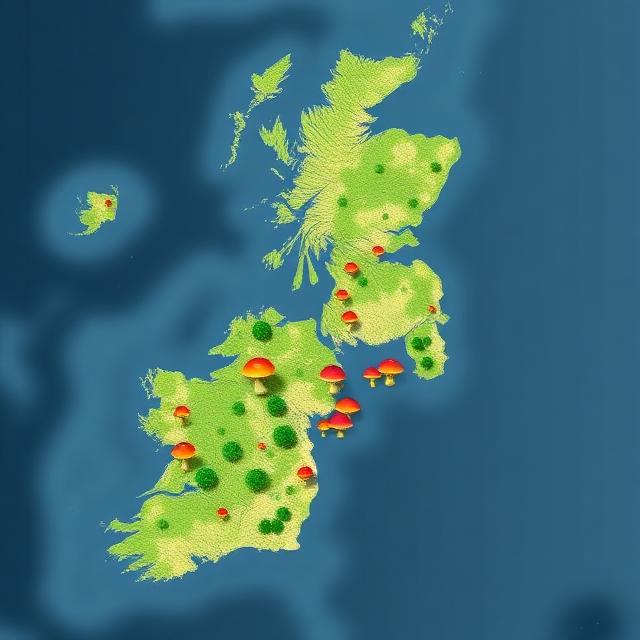
Shroom Map UK: Your Complete Guide to Finding & Sourcing Psilocybin Mushrooms in Britain
Introduction: Navigating the UK’s Psilocybin Landscape
The United Kingdom has a long, quietly documented history with wild psilocybin fungi. From the rain-soaked pastures of the Scottish Highlands to the rolling meadows of Somerset, magic mushrooms have been a part of Britain’s natural and cultural landscape for centuries. For researchers, mycologists, and curious enthusiasts, having an accurate shroom map UK is an indispensable starting point.
This guide is designed to give you a thorough understanding of where psilocybin mushrooms grow naturally across Britain, how to read the ecological signals that guide every credible shrooms map UK, and how to connect that knowledge with premium, quality-verified sources for collectors and researchers. Whether you’re studying fungal biodiversity or simply want to understand the terrain, this is your definitive companion.
What Is a Shroom Map UK — and Why Does It Matter?
A shroom map UK is a geographic reference tool — digital or field-based — that documents the known habitats, regional distributions, and seasonal fruiting patterns of psilocybin-containing mushrooms across Britain. These maps draw on decades of citizen science, mycological society records, and biodiversity databases.
They matter for several reasons:
- They help researchers track ecological changes in fungal populations
- They guide foragers and taxonomists toward productive habitats
- They contribute to broader biodiversity conservation efforts
- They support harm reduction by promoting correct species identification over guesswork
A well-researched shrooms map UK doesn’t just mark a field with a pin — it layers environmental data including soil acidity, land use history, grazing patterns, elevation, and rainfall averages to predict where conditions are most likely to support fruiting psilocybin species.
The Primary Species on Any Shrooms Map UK
Before examining specific regions, it helps to understand which species dominate the shroom map UK landscape. Several psilocybin-containing fungi are native to or naturalised in Britain:
Psilocybe semilanceata — The Liberty Cap
Undoubtedly the most iconic and widespread species on the shrooms map UK, Psilocybe semilanceata — the Liberty Cap — is a small, distinctive mushroom with a sharply pointed, nipple-topped cap. It grows almost exclusively in old, unfertilised grassland grazed by sheep or cattle.
Its range covers virtually every corner of Britain: from the Orkney Islands in the north to the Cornish coast in the southwest. This ubiquity makes it the cornerstone of any shroom map UK exercise.
Psilocybe cyanescens — The Wavy Cap
A more recently documented species on the shroom map UK, Psilocybe cyanescens thrives in wood chip-enriched substrates. It has colonised urban parks, garden borders, and woodland footpaths across England and Wales, making it an increasingly common feature of modern shrooms map UK databases.
Panaeolus cinctulus — The Ringed Panaeolus
Found in composted grassland, lawns, and garden beds, Panaeolus cinctulus occupies a different ecological niche than Liberty Caps but appears with growing frequency in southern English shrooms map UK records.
Regional Breakdown: Key Zones on the Shroom Map UK
Geography shapes everything. Here’s how Britain’s regions feature on any serious shroom map UK:
Scotland
Scotland is arguably the richest zone for any shrooms map UK researcher. The combination of cool, damp autumns, acidic upland soils, and extensive sheep-grazed hillsides creates near-perfect Liberty Cap habitat. The Cairngorms, Trossachs, and Borders regions all consistently appear in mycological records.
Wales
Wales punches above its weight on the shroom map UK. The Brecon Beacons, Snowdonia National Park, and the Welsh Marches are all well-documented Liberty Cap territories. Persistent Atlantic moisture and minimal agricultural intensification in upland areas keep many sites undisturbed and productive year after year.
Northern England
The Pennines, Yorkshire Dales, and Lake District all feature prominently on the shrooms map UK. These upland landscapes — characterised by thin, acidic soils and cool temperatures — support excellent Liberty Cap populations from late August through November.
Southwest England
Cornwall, Devon, and the Somerset Levels round out the southern reaches of the shroom map UK. The mild, wet climate extends the fruiting season slightly later into autumn compared to northern regions. Ancient, undisturbed pastures here are among the most consistently productive documented on any national shrooms map UK database.
Southeast & Midlands England
While less prominent than upland zones, the Southeast and Midlands still appear on the shroom map UK — particularly in relation to Psilocybe cyanescens, which has colonised many urban and suburban green spaces where fresh woodchip mulch is regularly applied.
Seasonal Timing: Reading the Shroom Map UK by Calendar
The shrooms map UK is never static — it shifts with the seasons. Understanding this temporal dimension is as important as the geographic one.
| Month | Shroom Map UK Activity |
|---|---|
| August | First flushes appear in Scottish uplands |
| September | Peak season begins across northern England and Wales |
| October | Nationwide peak — most active period on shroom map UK |
| November | Late season; Southwest England and lowland sites still productive |
| December–July | Dormant period for most Liberty Cap populations |
The trigger is temperature: Liberty Caps fruit reliably once soil temperatures fall below 12°C and overnight rainfall keeps ground moisture high. These conditions align with the classic British autumn — which is precisely why the shroom map UK is so consistently autumn-focused.
How to Use a Shrooms Map UK Responsibly
Geographic knowledge is only as valuable as the wisdom with which it’s applied. Here are the key principles for anyone engaging with a shrooms map UK:
Correct Identification Is Non-Negotiable
Misidentifying fungi can have serious consequences. Before relying on any shroom map UK to guide fieldwork, invest time in learning proper species identification. The British Mycological Society, field guides by Peter Jordan and Gary Lincoff, and community platforms like iNaturalist are excellent starting resources.
Know the Law
Psilocybin mushrooms are classified as a Class A controlled substance under the Misuse of Drugs Act 1971 in the UK. The shrooms map UK in this guide is intended strictly for educational, research, and taxonomic reference. Always operate within the law.
Contribute to Citizen Science
Platforms like iNaturalist and the Fungal Records Database of Britain and Ireland (FRDBI) actively welcome verified observations. Every responsible sighting you log makes the national shroom map UK more accurate and scientifically valuable for future researchers.
Sourcing Premium Psilocybin Mushrooms in the UK
For collectors and researchers who require professionally sourced, quality-verified psilocybin mushroom specimens rather than wild foraging, a trusted online supplier is essential.
Exodelics is one of the UK’s leading sources for premium psychedelic products, offering a curated range of psilocybin mushrooms that complement any serious mycological interest. Their catalogue includes some of the most well-documented strains referenced in global shrooms map UK research:
- Golden Teacher Mushrooms — A consistently popular strain known for smooth, introspective experiences and reliable morphology. Ideal for collectors and researchers seeking stable specimen characteristics.
- Penis Envy Mushrooms — One of the most potent and visually distinctive strains available. Widely referenced in collector communities for its unusual morphology and high psilocybin concentration.
- Blue Meanie Mushrooms — Named for its pronounced bluing reaction — a hallmark indicator of psilocybin content — the Blue Meanie is a firm favourite among enthusiasts.
- B+ Mushrooms — Renowned for adaptability and reliable fruiting characteristics, making it a solid reference specimen for beginners and experienced collectors alike.
- African Transkei Mushrooms — A visually striking strain from South Africa that has gained significant attention in collector and research circles for its unique characteristics.
Beyond mushrooms, Exodelics also stocks a broad range of psychedelic products including DMT, LSD, and edibles — all dispatched in discreet, plain packaging with fast UK delivery.
Digital Tools Supporting the Shroom Map UK
The shrooms map UK has evolved significantly in the digital age. Several platforms now maintain crowd-sourced, peer-reviewed fungal distribution data:
- iNaturalist — Global biodiversity mapping with verified UK psilocybin sightings
- British Mycological Society (BMS) — Peer-reviewed fungal distribution records
- Fungal Records Database of Britain and Ireland (FRDBI) — The most comprehensive academic shroom map UK resource
- Shroomery.org — Active community forums with regional UK foraging reports
These tools are increasingly used in tandem with commercial supplier databases to build a holistic picture of psilocybin mushroom availability and distribution across Britain.
Conclusion: Start Your Journey with the Right Knowledge and the Right Source
Whether you’re consulting a shroom map UK to understand ecological distribution or building a collection with professionally sourced specimens, the foundation is always the same: knowledge, quality, and responsibility.
Britain’s landscape is extraordinary in its support for naturally occurring psilocybin fungi. But for researchers, collectors, and enthusiasts who want consistent quality without the unpredictability of wild foraging, Exodelics offers a trusted, discreet, and comprehensive solution — delivering premium psilocybin mushrooms and psychedelics across the UK with speed, privacy, and reliability.
Use the uk shroom google maps to understand the terrain. Use Exodelics to source the quality.